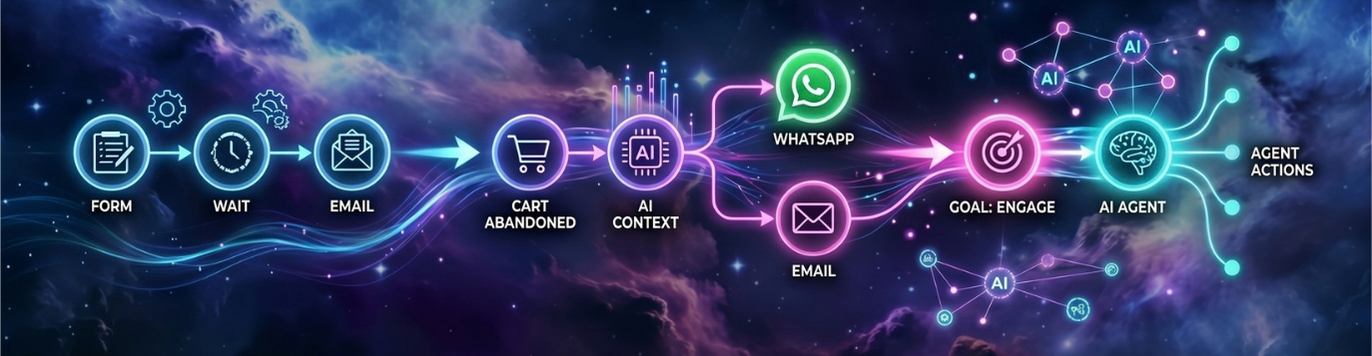
Traditional visualizations of marketing campaigns often resembled complex flowcharts. Marketing teams spent hours setting up branching decision trees: “If a user downloads an e-book, wait three days and send them a case study. If they don’t open the email within a week, send it again with a different subject line.”
This mechanical approach, based strictly on “if-then” rules, reliably served its purpose, but it had one fundamental weakness: it couldn’t respond to customer behavior that the predefined scenario didn’t account for.
Today, this model is reaching its technological and business limits. Customers have become immune to blanket email sequences. They expect communication tailored to their specific situation. Context and true relevance are what matter, not just the automatic delivery of a message on the right day.
From Executing Commands to Making Decisions
For a long time, marketing automation was viewed primarily as a tool for more efficient content distribution—a system that merely performs a pre-programmed task.
Modern platforms, enhanced with artificial intelligence, are shifting from execution to independent decision-making. They can analyze data from various sources in real time, evaluate the user’s broader context, and decide on their own what the next best step should be (known as “Next Best Action ”—an analytical approach that considers all available communication options and selects the one with the highest probability of success). In many cases, they can even create and implement this step on their own .
Instead of fixed, static paths, adaptive systems are taking their place—systems that learn from every interaction and continuously adjust their strategy.
The Direction of Automation
The difference between the old and new approaches is most evident when directly comparing how systems handle rules, content, and data.
| Parameter | Traditional marketing automation | Modern AI automation |
| Process logic | Fixed sequences and clearly defined rules. | Dynamic workflows and decision-making based on user context. |
| Customer journey creation | A person manually models and configures each step. | AI analyzes data and helps design or adjust the journey on the fly. |
| Working with Segments | Manually moving contacts between static lists. | Predictive segmentation (the system automatically recognizes purchase intent and adjusts priority). |
| Content personalization | The same content for the entire segment (often with only a personalized greeting). | Hyper-personalization (content and offer variations tailored to the individual). |
| Analytics and reporting | Descriptive (the report only shows what has already happened). | Predictive and prescriptive (the system explains the reasons and suggests next steps). |
| Role of the system | The tool passively performs the specified action. | An autonomous agent can interpret data and perform a multi-step task. |
This shift does not mean that old approaches are disappearing entirely; they are still suitable for simple transactional processes. It does mean, however, that traditional automation is becoming just one element of a much broader and more intelligent ecosystem.
Architecture and Pillars of Modern Automation
For marketing automation to function autonomously and across various communication channels, it requires a solid technological foundation. Standalone email marketing tools are no longer sufficient for effectively managing the customer journey. The modern ecosystem rests on four main pillars.
Data Centralization as the First Step
High-quality automation starts with clean and interconnected data. Isolated systems cannot provide the full context. The foundation is therefore a CRM (Customer Relationship Management) system or a CDP (Customer Data Platform).
These systems consolidate order history, email activity, web behavior, and customer support tickets into a single profile. If a customer filed a valid complaint yesterday, the interconnected system will automatically pause the delivery of aggressive sales newsletters to that customer today.
Dynamic Segmentation and Predictive Scoring
Marketing departments no longer need to manually move contacts between static lists. Users are automatically assigned to different segments based on their current behavior. This is complemented by predictive lead scoring (a scoring system for contacts).
Artificial intelligence analyzes dozens of interactions and automatically assigns users a score based on the likelihood that they will make a purchase in the near future. This allows the sales team to focus exclusively on the highest-priority opportunities.
Intelligent Omnichannel Approach
True omnichannel (multi-channel communication) does not mean sending the exact same message via email, text message, and social media. It’s about intelligently managing the customer journey. If the system detects that a customer has been ignoring emails for a long time, it does not attempt to reach out to them with another email campaign.
Instead, on their next visit to the website, it will display a personalized banner or securely transfer their data to advertising platforms for targeted remarketing. The individual channels complement each other and respect the user’s preferences.
Personalization 2.0
Simply addressing a customer by their first name in the subject line no longer provides any added value. Advanced personalization focuses on dynamically adapting the content itself.
Today’s systems can generate product recommendations based on past behavior, change elements on a webpage according to the current stage of the purchase cycle, or individually adjust the amount of a discount offered so that a company can maximize its conversion rate while protecting its margin.
Artificial Intelligence and Autonomous Agents in Practice
While the first wave of artificial intelligence in marketing focused primarily on text generation, current developments have shifted toward the orchestration of entire processes. A key innovation is the emergence of autonomous AI agents.
The difference between conventional artificial intelligence and an agent lies in the degree of autonomy. A standard AI model generates a draft email upon command. An autonomous agent is given a broader objective (such as “process new business inquiries”), determines the context on its own, proposes the optimal course of action, prepares personalized communication, and then creates a task for a specific member of the sales team.
Today, these systems serve not only as smart copywriters but also function as real-time analysts and strategists:
- Automatic repurposing (content reworking): The system can analyze source material (such as a webinar recording) and automatically extract the maximum value from it. It prepares an outline for a newsletter, several versions of social media posts, and a brief summary of key points for the sales department.
- Dynamic testing and optimization: Instead of manually deploying two email variants, AI can continuously test dozens of combinations of subject lines, text, and graphics, and automatically prioritize the versions that deliver the best results.
- Send Time Optimization: Algorithms analyze historical data for each individual contact and deliver the message at the exact moment when that user typically opens emails or checks notifications.
E-commerce: Maximizing Customer Value
In online retail, autonomous automation primarily ensures that the company effectively leverages its database and does not unnecessarily reduce its margins with blanket discounts.
- Smart Abandoned Cart: If a customer does not complete a purchase, the system does not automatically generate a 10% discount for everyone. AI evaluates the customer’s purchase history, price sensitivity, and the current margin on the products in the cart. For example, it will offer a high-value customer only free shipping or educational content, while providing a discount to a hesitant first-time buyer.
- Churn prediction: The system continuously analyzes purchase frequency and website behavior. If it identifies customers at risk of switching to a competitor, it proactively launches a retention campaign (aimed at maintaining the relationship) before they actually stop shopping.
- Next-Purchase Prediction: Based on the consumption cycle of specific products (such as cosmetics, pet food, or dietary supplements), the system accurately estimates when a customer is likely to run out of a product and sends a timely reminder to restock, with the option to purchase with a single click.
B2B Sector: Integrating Marketing and Sales
In the B2B (Business-to-Business) segment and when using ABM (Account-Based Marketing—marketing focused on specific key companies), agents play a role in providing analytical and administrative support that shortens the sales cycle.
- Intelligent Lead Routing: New leads (potential customers) are no longer assigned to sales representatives at random or alphabetically. The system takes into account the region, industry, company size, and current workload of individual sales representatives, and sends the lead to the person most likely to close the deal.
- SLA (Service Level Agreement) Automation: The platform strictly monitors internal agreements regarding response times. If a sales representative does not contact a high-priority lead within a predetermined time (for example, within two hours), the system automatically escalates the lead to a manager or redirects it to an available colleague so that the valuable opportunity does not go cold.
- Agent Research and Brief Preparation: Before the sales representative picks up the phone, an AI agent reviews available data on the target company and summarizes its recent activity on the company’s website. It delivers a clear summary of key information directly to the CRM or communication platform (e.g., Slack, Teams), including suggested topics for the call (so-called “icebreakers”).
Strategic Challenges and Principles of Successful Implementation
Relying on advanced technologies also carries specific risks. Autonomous systems may seem like a one-size-fits-all solution, but in practice, they encounter technological and legislative limitations that must be taken into account as early as the solution design phase:
- The “Garbage In, Garbage Out” Principle: The quality of the output is directly proportional to the quality of the input data. Artificial intelligence cannot, on its own, correct a neglected database. Duplicate, incomplete, or outdated records in the CRM lead to erroneous system decisions. Automating poor-quality data will only accelerate its negative impact.
- Loss of authenticity and human oversight: A complete absence of human control can lead to inconsistencies in messaging or factual errors in content. The gold standard in an enterprise environment is therefore the “human-in-the-loop ” model . The system takes on the analytical and creative workload, but final strategic decisions or the approval of critical outputs remain in the hands of specialists.
- Privacy and Legislation: As systems’ ability to analyze user behavior grows, so does the pressure to ensure data security. Strict compliance with regulations such as the GDPR and transparentconsent management are no longer merely formal obligations but essential technical components of the entire process.
A Phased Transition to Intelligent Processes
Implementing advanced automation does not require an immediate overhaul of the entire marketing department. The fundamental rule is not to automate inefficient processes. The most successful integrations follow these logical steps:
- Data audit and centralization: Before deploying new technologies, it is necessary to review existing contacts, remove duplicates, and consolidate fragmented information from various sources into a single central repository.
- Identifying Obstacles: Rather than attempting to automate the entire customer journey, it is more effective to focus on a single specific problem. A typical example might be the slow process of transferring Marketing Qualified Leads (MQLs ) from the marketing department to the sales department.
- Establishing a Reliable Foundation: Basic trigger rules are first set up in an isolated section. The goal is to verify that the data flow works flawlessly and that the system reliably responds to default events without complex predictions.
- Gradual Activation of AI and Analytics: Only after the basic processes have stabilized does it make sense to integrate intelligent add-ons. This phase includes the deployment of predictivelead scoring, dynamic content personalization, and optimization of send times.
- Measuring Real Business Value: The success of the implementation must not be evaluated based on standard metrics, such as the simple email open rate. It is essential to track whether the system demonstrably generates relevant leads, shortens the sales cycle, and increases the return on the entire investment.
-
The shift from rigid rules to autonomous systems means that marketing automation no longer serves merely as a blanket distributor of content. It is becoming a full-fledged analytical partner capable of listening to data, understanding context, and offering users real value exactly when they need it.
Conclusion
The era when marketing automation meant nothing more than mass-sending pre-programmed emails is definitively coming to an end. Today’s technologies have transformed these systems from passive executors into autonomous partners.
Thanks to artificial intelligence and deep data integration, platforms today can analyze customer behavior in real time, accurately predict purchase intent, and independently take the steps that lead to a successful sale.
If you find that your current processes resemble a mechanical routine rather than a smart partner, we’d be happy to help you change that. We specialize in data audits, system integration, and the strategic implementation of modern marketing automation.
Schedule a no-obligation consultation with us at, and let’s work together to discover how autonomous AI systems can streamline your business.