


Implementing CRM and ERP systems has been our core business for the past seven years. HubSpot, Salesforce, Zoho, Pipedrive, Odoo: We choose a platform based on the client’s actual needs, not on whose logo we need to display on our website. As a result, today we convince a significant number of clients to purchase a license right after the first audit. Not because we’ve turned our backs on established platforms, but because of the actual numbers.
1. How AI Has Rewritten the “Build vs. Buy” Equation
The short answer is: AI hasn’t settled this age-old debate. It has strengthened both sides and radically divided the market.
Just a few years ago, a simple rule applied. Developing a custom enterprise system meant months or even years of work and a budget in the millions of crowns. On the other hand, there was an off-the-shelf solution with an extensive ecosystem of integrations. The “buy” option almost always won out. The advent of advanced AI has changed this equation twice—but each time in a different direction.
- Off-the-shelf solutions have become significantly more powerful. Today, every major ecosystem has its own AI layer and a defined framework for customization. The routine tasks that used to require expensive add-ons are increasingly becoming a natural part of the base license. The analytics firm Gartner summarizes this trend with a prediction that by the end of 2026,40% of enterprise applications will include AI agents, up from just under 5% in 2025.
- Custom development has become more accessible, but it comes with its own risks. On this point, we need to be more precise than most of the market. AI-assisted development does indeed speed up code delivery; for example, GitHub reports that its Copilot tool merges changes roughly 50% faster. However, hard data on security and architectural complexity paint a very different picture.
The main argument for custom development (build) is therefore not that AI will build everything cheaply and on the spot. The real benefits are full ownership, solution precision, and independence from licenses—provided the system is delivered by a team capable of professionally managing and securing AI development.
2. What MIT, Gartner, and METR Actually Found
Making an informed decision about enterprise architecture requires stepping back from marketing promises and looking at real-world data from recent months:
- The Speed Paradox (METR 2025): A randomized study by the METR Institute showed that experienced developers using AI tools were actually 19% slower at solving complex software tasks , even though they themselves subjectively estimated that they were working 20% faster. AI reliably speeds up the writing of routine code, but requires extreme human oversight when designing complex architecture.
- Security Risks (Veracode 2025): Up to 45% of AI-generated code contains known security vulnerabilities. Building a company’s CRM on your own over a weekend with the help of AI generators is a surefire recipe for a future security incident.
- The Success Gap (MIT NANDA 2025): The most important figure in this entire debate came from a large-scale study titled “GenAI Divide” by the Massachusetts Institute of Technology (MIT), conducted on a sample of hundreds of enterprise deployments. It found that 95% ofenterprise AI pilots will not yield measurable financial results. The key difference lies in the approach: solutions purchased or delivered by a partner succeed in roughly 67% of cases, while purely in-house DIY attempts have a success rate of only 33%.
The main lesson for management, therefore, is not that you shouldn’t build custom solutions. It is: don’t build complex systems on your own without an experienced partner.
3. The Winning Trio: Build, Buy, or Blend
Gartner now frames managers’ decision-making with the “Build, Buy, or Blend”concept , which aligns perfectly with our day-to-day project experience: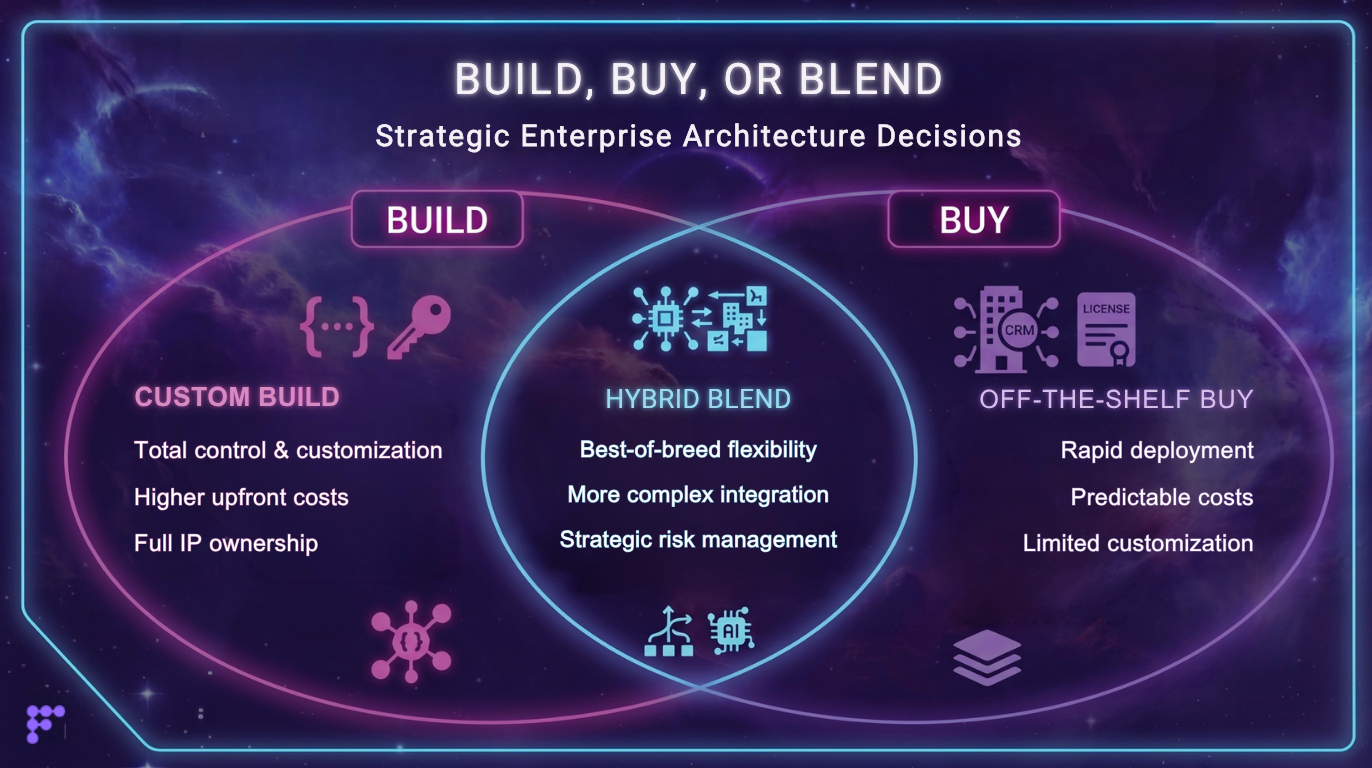
-
Buy: Deploying a platform, including its native AI and customizations within the rules of the given ecosystem. This provides a quick start, enterprise governance, out-of-the-box integrations, and the assurance of long-term continuity.
-
Build: Developing your own system built precisely according to your processes, operated by autonomous AI agents. This eliminates licenses that increase with each new user, and the software fully adapts to the company—not the other way around.
-
Blend: Leverage the platform’s core where it excels (typically sales pipelines and marketing), combined with your own AI layer for specific processes that no platform on the market reasonably covers.
Moore’s Rule (Core vs. Context)
Geoffrey Moore defined a very useful conceptual framework long before the advent of AI: distinguish between “core” and “context”in business . The processes that set you apart from the competition and generate profit (Core) deserve a tailor-made solution.
Everything else that merely keeps the company running (Context) is best purchased as a ready-made product. The consulting firm McKinsey offers the same recommendation. Artificial intelligence hasn’t changed this rule; it has merely shifted the economic threshold at which in-house development becomes worthwhile.
4. When Does “Buy” Make Sense? (An Overview of AI Platforms)
For a large number of companies, purchasing a platform is the most sensible approach. These are typically larger organizations with a complex sales team and detailed forecasting, companies dependent on a broader ecosystem (marketing automation, partner portals, marketplace integrations), and generally operations where internal policies and continuity take precedence over the need for a perfect functional fit.
The key question for these companies is not whether to build or buy. The crucial decision is which ecosystem to choose and how deeply to customize it so that the system remains sustainable in the long term. Here, the role of an independent implementer with knowledge of multiple platforms is irreplaceable.
Comparison of Native AI Layers in 2026
| Platform | AI Layer | Model Used | AI Pricing Model | Best Fit |
| HubSpot | Breeze (agents, Studio, Context Layer) | Proprietary + Partner LLMs | HubSpot Credits used beyond the license | Medium and large companies integrating marketing and sales |
| Salesforce | Agentforce 360 | Proprietary platform + LLM | Flex Credits (pay-per-action/conversion) | Enterprise segment, complex sales organizations |
| Zoho | Zia, Agent Studio | Proprietary Zia LLM | Included in paid licensing plans | Value-focused SME and mid-market segment |
| Pipedrive | AI Sales Assistant | OpenAI (in higher plans) | Included in higher plans | Small and dynamic sales teams |
| Odoo | Ask AI, AI Agents (v19) | Gemini / OpenAI (API) | The client pays the API provider directly for API usage | Companies building their operations on Odoo ERP |
What to Watch Out For: Credit Tax and “Agent Washing”
Platform providers are reluctant to point out that “AI included” in large systems usually means a consumption-based credit model. For example, HubSpot Credits or Salesforce Flex Credits are deducted based on actual activity. You must therefore calculate the total cost of ownership based on a realistic estimate of AI usage, not just the price list for basic user licenses.
At the same time, we recommend caution regarding a phenomenon that Gartner refers to as “agent washing” —that is, slapping a flashy “AI agent” label on old, simple automations. With off-the-shelf solutions, always verify what the AI layer can actually do in real-world operation with your data, not just in marketing presentations.
5. When “Build” Wins: Proven in Real-World Operations
Developing your own solution wins out when processes are unique, the proportion of routine work is high, and the cost of standard licenses would rise much faster than the added value for the company. Given that, according to MIT, internal development efforts succeed in only one-third of cases, we always provide the most essential elements for in-house solutions: appropriate architecture, a thorough code security audit, and a long-term operational model.
The best way to verify this theory was to test it on our own project.
From Practice: The Wavepouch Project
Wavepouch is a D2C e-shop that we own and operate ourselves. This has allowed us to push automation to its technological limits and fully automate 99 percent of its day-to-day operations.
Order processing, customer support, logistics, financial reporting, and part of our marketing now run on our own system of autonomous AI agents. Tasks that would require the work of several people in a typical e-shop now require only a few hours of human time per month for supervision and strategic decisions.
6. The Main Question and 5 Key Decision-Making Criteria
During every discovery phase, we work with clients using a proven framework that prioritizes data quality above all else.
The fundamental question: Is your data ready?
Analysts at MIT have identified poor-quality, unprepared, and fragmented data as the main reason for the failure of AI projects, regardless of whether the solution is off-the-shelf or custom-built. If your answer is no, don’t worry about the “build vs. buy” dilemma just yet . Your first investment must go toward consolidating and cleaning up your databases.
Once you’re confident your data is clean, it’s time to ask these5 key questions:
1. How unique are your processes?
Standard B2B business aligns with the logic of off-the-shelf platforms, whose configuration options cover even common industry-specific requirements. However, if implementation requires dozens of non-standard modifications and forcing the system to operate contrary to its intended purpose, you’re choosing the wrong product. From a Moore’s Law perspective: is the process in question part of your core or your context?
2. Does the value increase with the number of users, or is it just the cost?
A salesperson who actively works in the CRM all day can easily justify their license. In a company where dozens of employees merely passively view the system or approve individual tasks, you’re paying an unnecessarily high licensing fee. In such a case , a “build” or “blend” approachmakes economic sense .
3. What percentage of the work consists of routine tasks, and can native AI platforms handle them?
The answer requires two steps. First, quantify how much time is spent on data entry, reporting, and administrative tasks. Then, verify whether tools like Breeze, Agentforce, or Zia can handle these tasks within the scope of the license you’re considering purchasing. If so, choose “Buy.” If your routine tasks fall outside their capabilities (for example, in specific technical support or manufacturing logistics), in-house agents will yield greater savings.
4. How extensive do your integrations need to be?
A standard ecosystem of cloud applications with off-the-shelf connectors is a strong argument for purchasing a platform. Conversely, working with legacy ERP systems, specialized accounting software, or manufacturing technologies often means that a custom integration (build) will be more stable and cost-effective than modifying the platform via integration middleware.
5. Who will take responsibility for operations in three years?
This is historically the most valid objection to in-house development. Gartner predicts that over 40% of agency AI projects will be canceled by the end of 2027 due to uncontrolled costs and a lack of maintenance. That’s why we never deliver in-house systems as one-time projects, but rather as a long-term service that includes monitoring, maintenance, security, and further development—all backed by a full guarantee on our part.
7. Hidden Costs of Both Approaches (TCO Reality Check)
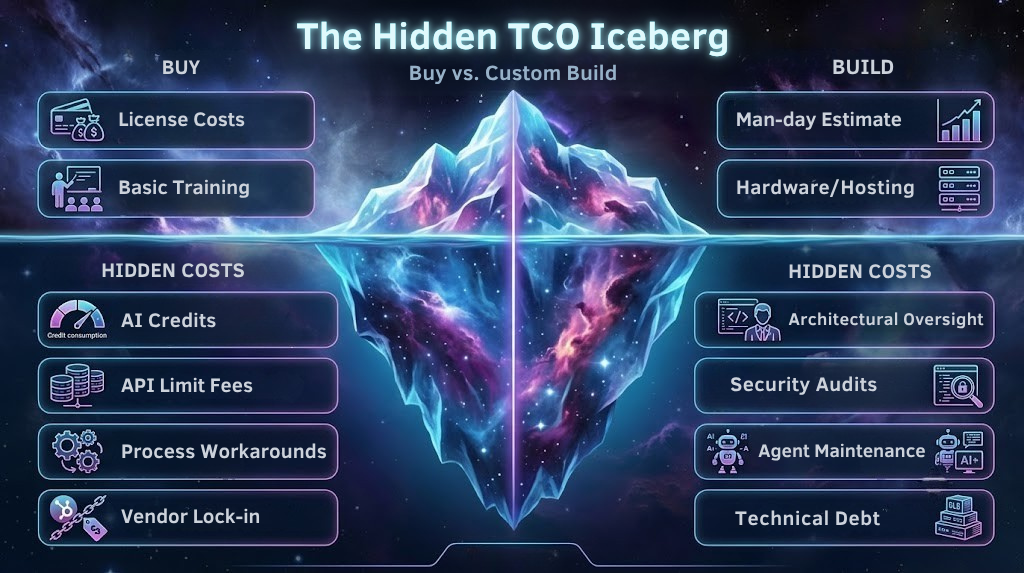 The truth is that you’ll always have to pay; it’s just a matter of the cost structure.
- The Hidden Cost of Purchase (Buy): The total cost of ownership (TCO) over 3 to 5 years isn’t just the license invoice. It includes rapidly rising AI credit consumption, necessary process compromises, andvendor lock-in. The well-known rule from Mark Lutchen, former CIO of PwC, still holds true: 70% of the costs of enterprise software arise only after its implementation.
- The Hidden Cost ofIn-House Development (Build): The price of a custom-built system lies in the need for systematic maintenance, managing technical debt, and ensuring security. In-house software without a clearly defined operating model and an experienced architect ends up falling precisely into the failure statistics cited by MIT.
- The human factor as a common denominator: As many as 50 to 55% of all CRM projects fail. The overwhelming majority of them fail due to poor adoption and mismanaged change management, not because of the technology itself. A poorly implemented HubSpot will lose out to a well-built in-house system, and the reverse is also true.
How to Decide – Automation Audit
You can evaluate both the initial question and the five key criteria internally within your company. However, if you prefer a decision based on precise data and real-world experience from hundreds of implementations, we’ve transformed our discovery phase into a standalone product: Automation Audit.
Over the course of three weeks, for a predetermined fixed price:
-
We’ll map out your business processes and clearly separate your core agenda from administrative tasks.
-
We’ll quantify routine tasks and calculate the actual return on investment from automating them.
-
We’ll build a TCO model for both approaches over the next three years, including predictions for AI credit consumption and long-term management costs.
The output is an executive blueprint with a clear recommendation on whether to go the “buy,” “build,” or “blend” route, including the selection of a specific technology. The conclusion could very well be: “Buy Zoho, don’t build anything custom, and follow this configuration schedule.”
It only makes sense to conduct an audit with a partner who routinely operates both approaches in practice. This is the only way to get a truly independent recommendation that doesn’t push a pre-selected technology on you.



.jpg)